
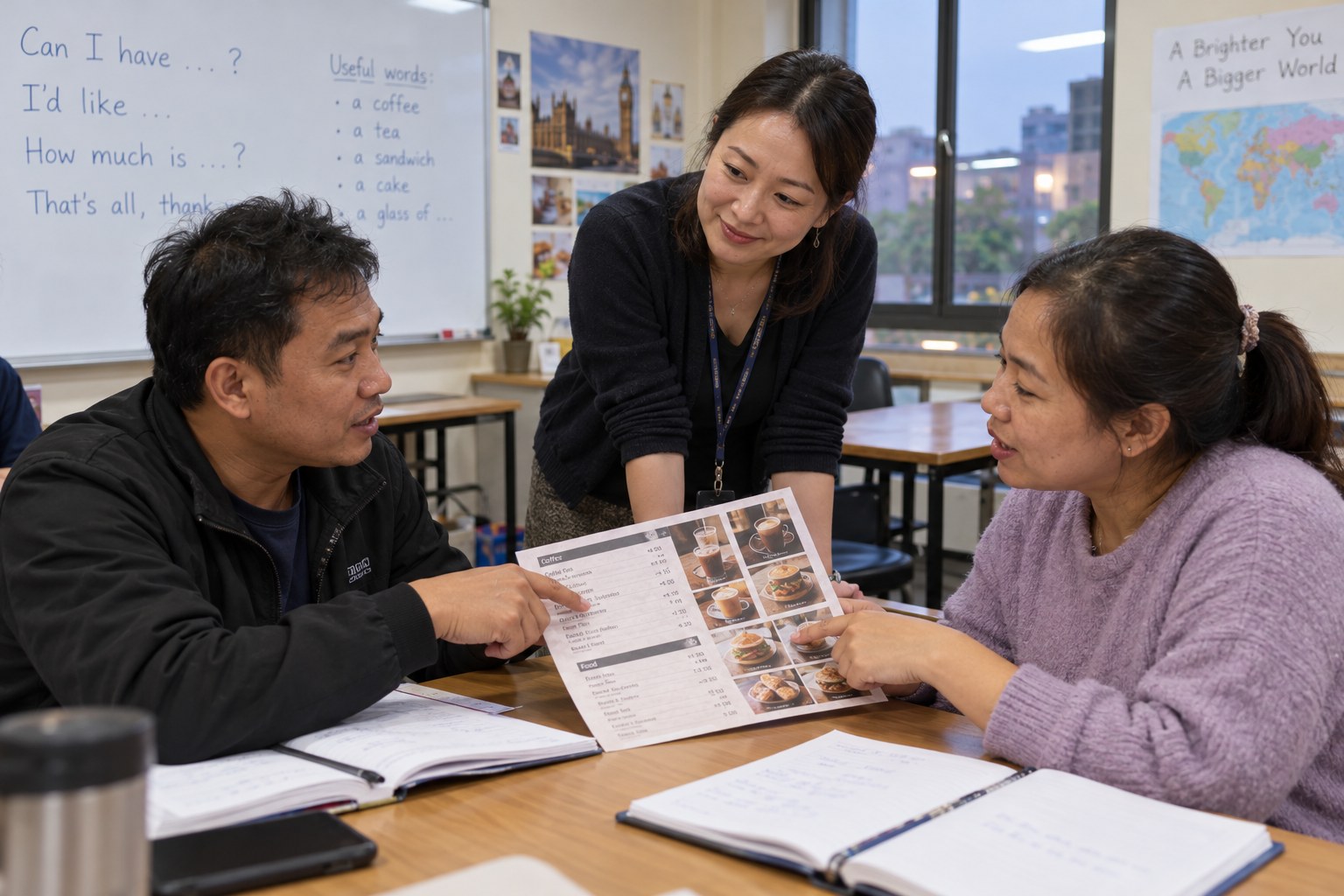
An adult who cannot yet hold a conversation in English may already manage a business, raise a family or solve complicated problems every day. Your first lesson should respect that experience while making the language manageable. The aim is a small, useful success that learners understand and can repeat outside the classroom.
Begin with real situations rather than a long grammar checklist. Do learners need to speak with customers, travel, introduce themselves at work or understand messages from a child’s school? Use pictures, a brief translated questionnaire or support in a shared language where appropriate. You are gathering information, not testing how well someone can guess your instructions.
Choose one priority that several learners share. For example, a group preparing for travel might practise ordering a drink. Someone who needs workplace English may benefit more from confirming a name and phone number. Keep a note of individual goals so future lessons connect with what brought people to class.
Beginner English does not describe one uniform learner. One person may read confidently in another language but find the Roman alphabet unfamiliar. Another may recognise written English yet struggle to follow speech. Others may need support with reading and writing more generally. Avoid drawing conclusions about intelligence or motivation from any of these differences.
Use a few low-pressure tasks to see what support is needed: match an image to a word, listen and point, copy a name, or answer a familiar greeting. Introduce the purpose before each task and offer help. If print is a barrier, use objects, photographs and oral rehearsal while building literacy gradually rather than making a written worksheet the gateway to participation.
Write a concrete lesson goal: by the end, learners can order one drink and respond to a simple follow-up question. That gives you a clearer planning target than covering food vocabulary or teaching polite requests. Choose a small set of items your learners are likely to use.
For a café lesson, begin with coffee, tea and water, plus a short request and a response. You do not need to introduce every size, flavour, payment method and possible question at once. Prepare a small picture menu with clear prices and readable print. If a learner already knows the core language, offer a useful extension such as asking the price while others consolidate the basic exchange.
Show a short exchange using the menu and a cup. Play both roles or demonstrate with a confident volunteer who has agreed to help. Let learners watch once for meaning, then repeat the exchange more slowly with pauses. Point to the relevant picture so understanding does not depend on a long verbal explanation.
Give instructions in short steps and demonstrate the first turn. Instead of asking whether everyone understands, ask someone to show which role starts or point to what they will order. Allow quiet rehearsal before public speaking. Pairs can practise with the same partner first, then change roles. Familiarity with the procedure leaves more attention available for the new language.
For an illustrative 60-minute lesson, allow roughly ten minutes for goals and a familiar warm-up, ten for the model and meaning, ten for pronunciation and short rehearsals, twenty for pair exchanges, and ten for a final task and review. Adjust the timing to the class; this is a planning example, not a fixed formula.
Keep the purpose stable while changing one detail. Learners might order from the first menu, switch customer and server roles, then choose from a second menu with different prices. Leave sentence starters available initially and gradually cover parts that learners no longer need. Circulate quietly, offer prompts and notice who needs another demonstration before adding new language.
During a rehearsal, help with pronunciation or word order that prevents the message from being understood. Model the phrase, invite another attempt and return to the exchange. During a more independent task, let the learner finish where possible and save a small number of shared points for afterwards. Avoid turning every sentence into an interruption.
Use adult situations and clear materials without making the lesson visually childish. Speak naturally and clearly, allow thinking time, and avoid treating louder or faster answers as the only evidence of learning. Learners can first rehearse privately or with a partner. Praise specific progress, such as responding without reading the prompt, so feedback tells people what they are becoming able to do.
End with a short exchange using a new menu or partner. Notice whether learners can make their choice understood and respond to the question you practised. Record one next step for your planning. If many still need the full model, begin the next lesson with another supported version rather than racing to a new topic.
Offer homework that fits adult lives: practise the exchange aloud twice, label three familiar objects, or make a short private voice recording if suitable. Do not require an expensive app or public upload. Ask learners which phrase they expect to use this week. For further planning support, explore the Global School Scout teaching blog and the British Council resources linked below.
Further reading: British Council TeachingEnglish: Teaching speaking pathway. The café task and suggested timings are original illustrative planning examples; adapt them to learner needs.


Site help, FAQs, blogs, and how our Scouts work